
Documents Conference of Cardinal Ratzinger, 24 October 1998
Ten years after the publication of the Motu
Proprio Ecclesia Dei how does the account stand? Above
all, I think it is an opportunity to show our gratitude and give
thanks. The different communities born from this pontifical document,
have given the Church a great number of priestly and religious vocations,
zealous, joyful and profoundly united to the Pope, to serve the
Gospel at this era in history, our era. Through them many faithful
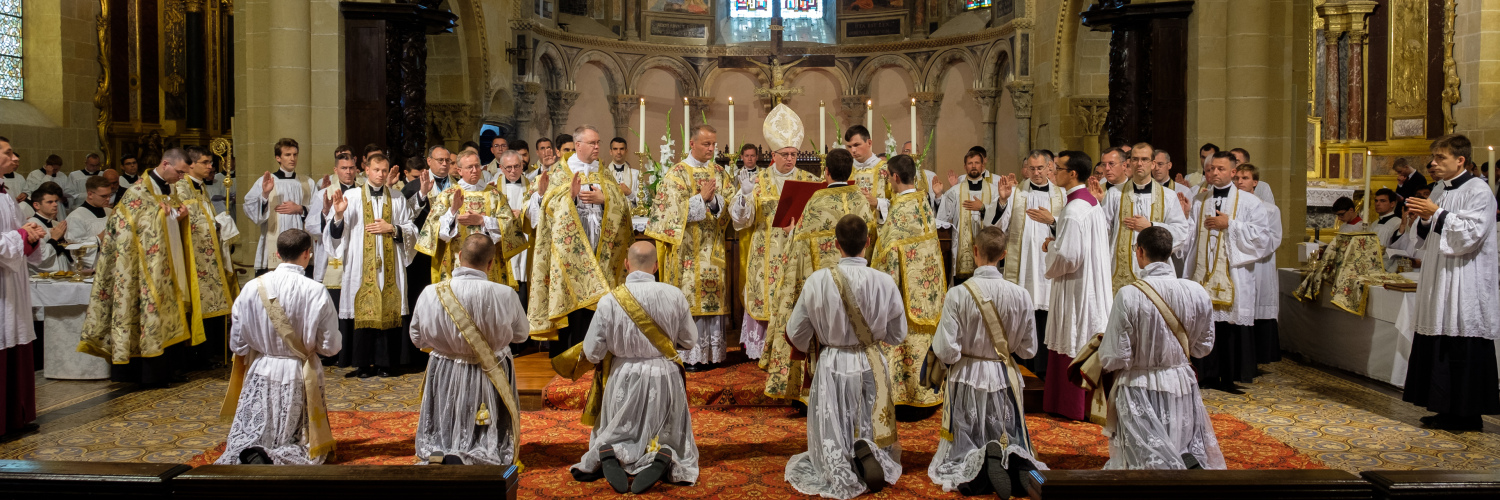
have been confirmed in their joy to be able to live the liturgy
and in their love for the Church where may be they have found the
two. In several dioceses -and their number is not so small- they
serve the Church in collaboration with the Bishops and in a brotherly
way with the faithful who feel at home in the renewed form of the
new liturgy. All this cannot but urge us to gratitude today!
To wish to pass over in silence the less good things would, however,
not be very realistic. In many places difficulties persist and continue
to persist, because bishops as well as priests and faithful consider
this attachment to the ancient liturgy an element of division, which
only troubles the ecclesial community and gives rise to suspicions
about a conditional acceptance of the Council and more generally
suspicion about obedience to the legitimate Pastors of the Church.
We must now ask the following question: how can these difficulties
be overcome? How can one build the necessary confidence so that
these groups and communities which love the ancient liturgy may
be able to be integrated peacefully into the life of the Church?
But there is another question underlying the first: What is the
deep reason for this scorn or even refusal of the continuation of
the ancient liturgical forms?
In this matter certainly, it is possible that reasons exist anterior
to any theology -reasons which originate in the characters of individuals,
which originate in the opposition of different characters or originate
even other completely external circumstances. It is certain, however,
that there are also more profound reasons which explain these problems.
The two most often heard are the lack of obedience to the Council
which reformed the liturgical books and the rupturing of unity which
must necessarily follow, if one allows other different liturgical
forms to continue. It is relatively easy to refute in theory these
two arguments. The Council itself did not reform the liturgical
books but rather ordered their revision. To that end it laid down
some fundamental rules.
Primarily the Council defined what liturgy is
and this definition gives valid criteria for every liturgical celebration.
If one wishes to scorn these essential rules and to put aside the
normae generales which are bound at numbers 34 to 36 of the
Constitution "De Sacra Liturgia", then one violates
obedience to the Council! One must judge liturgical celebrations,
whether they be according to the old or the new liturgical books,
based on these criteria. It is good to remember here what Cardinal
Newman realized when he said that the Church in all her history
has never abolished or defended orthodox liturgical forms (forms
which express the true faith) which would be totally foreign, to
the spirit of the Church.
An orthodox liturgy (a liturgy which expounds the true faith)
is never a compilation drawn up according to the pragmatic criteria
of diverse ceremonies, of which one can dispose positively and arbitrarily,
this way today, that way tomorrow. The orthodox forms of a rite
are living realities, born of the dialogue of love between the Church
and Her Lord. They are the expressions of the life of the Church
where the faith, the prayer and the very life of generations is
condensed and where at same time the action of God and the response
of man is enfleshed in a concrete form. If the subject which has
borne certain rites historically disappears or if the subject is
transplanted into another environment, these rites can perish. The
authority of The Church can define and limit the use of rites in
different historical situations. She never defends them purely and
simply! The Council, therefore, ordered a reform of the liturgical
books but it never forbade the previous books. The criterion which
the Council enunciated is both vaster and more demanding. It invites
everyone to self-criticism! We will return to this point.
One must examine the other argument which pretends
that the existence of two rites can fracture unity. One must distinguish,
here, the theological from the practical side of the question. Theologically
and fundamentally one has to realize that several forms of the Latin
Rite have always existed and that they retreated but slowly only
as Europe was unified. Up to the Council, there existed along side
the Roman Rite, the Ambrosian Rite, the Mozarabic Rite of Toledo,
the Rite of Braga, the Rite of the Carthusians and the Carmelites
and the best know the Dominican Rite; and perhaps other ones which
I do not know. Nobody was ever scandalized that the Dominicans,
often when present in parishes, did not celebrate like parish priests
but rather had their own rite. We had no doubt that their rite was
both Catholic and Roman. We were proud of the richness of having
several rites. The free space which the new order of Mass gives
to creativity it must be admitted, is often excessively enlarged.
The difference between the Iiturgy with the new liturgical books,
as it is actually practiced and celebrated in various places is
often much greater than the difference between the old and new liturgies
when celebrated according to the rubrics of the liturgical books.
An average Christian without special liturgical formation would
be hard pressed to distinguish a Sung Mass in Latin according to
the Old Missal from a Sung Mass in Latin celebrated according to
the New Missal. The difference, by contrast, can be enormous between
a liturgy faithfully celebrated according to the Missal of Paul
VI and the concrete forms and celebrations in the vernacular with
all the possible freedom and creativity! With these considerations
we have already crossed the threshold between theory and practice
where matters are naturally more complex since the question of human
relationships arises.
The alarm of which we have spoken is so great, I think, because
one is contrasting two forms of celebration with two different spiritual
outlooks. One is contrasting two different ways of perceiving the
Church and Christian existence. The reasons for this are several.
Firstly, one judges the two liturgical forms by their exterior elements
and arrives at the conclusion that there are two fundamentally different
outlooks. That the new liturgy be celebrated in the vernacular,
facing the congregation and that there be great leeway for creativity
and the active exercise of roles by the laity, is considered essential
by the average Christian. On the other hand, it is deemed essential
that the old liturgy be in Latin, the priest face the altar, that
the rite be strictly controlled and that the faithful follow the
Mass by praying privately without having an active role. From this
view appearances and not what the liturgy itself considers important,
are essential for a liturgy. One must realize that the faithful
understand the liturgy from visible concrete forms and that they
are spiritually impregnated by them and that the faithful do not
penetrate easily the depths of the liturgy.
The contradictions and oppositions which we have enumerated do
not come from either the spirit or the letter of the Council documents.
The Constitution on the Liturgy itself does not mention at all celebration
facing the altar or the congregation. On the matter of language,
it says that Latin must be conserved while at the same time giving
the vernacular a larger role, "especially in the readings,
the directives and in some prayers and chants" (SC 36:2). As
to lay participation, the Council insists firstly and generally,
that the liturgy is essentially the business of the entire Body
of Christ, Head and members, and so it belongs to the entire Body
of the Church "and it is consequently intended to be celebrated
in community with the active participation of the faithful."
And the text makes clear that "in liturgical celebrations,
everyone one, minister or faithful, in fulfilling his function,
does only and fully what belongs to him by virtue of the matter
and the liturgical norms" (SC 28). "To promote active
participation, one will encourage the acclamations of the people,
their responses, the chant of the psalms, antiphons, canticles and
other actions and gestures and bodily positions. One will observe
a holy silence in its time" (SC 30).
Here then are, the Council directives. They can give everyone
matter for reflection. There is unfortunately a tendency, amongst
some modern liturgists, to develop the ideas of the Council in one
direction. One overturns the intentions of the Council, acting in
this way. The role of the priest is reduced by some to the purely
functional. The fact that the entire Body of Christ is the subject
of the liturgy is often deformed to the point where the local community
becomes the self-sufficient subject of the liturgy and it allots
the various roles. There also exists a dangerous tendency to minimalise
the sacrificial nature of the Mass and to make the mystery and the
sacred disappear under the so-called imperative pretext of making
oneself more easily understood. Finally, one notices the tendency
to fragment the liturgy and the unilateral emphasizing of its communitarian
character by giving the assembly the power to decide about the celebration.
Happily, however, there is a certain disgust for a rationalism
full of banality and the pragmatism of certain theoretical and practical
liturgists. One notices a return to mystery, and to adoration and
the sacred, and to the cosmic and eschatological nature of the liturgy.
To this, the Oxford Declaration on the Liturgy of 1996 bears witnesses.
On the other hand one has to admit that the celebration of the ancient
liturgy was too lost in the realm of the individual and the private.
One must admit that the communion between the priest and the faithful
was lacking. I have great respect for our ancestors who during the
Low Mass, said the prayers "during Mass" which their prayer
book recommended. Certainly one cannot consider that as the ideal
of the liturgical celebration! Perhaps, these reduced forms of celebration
are the fundamental reason why the disappearance of the ancient
liturgical books had no importance in many countries and caused
no pain, There was never any contact with the liturgy itself. On
the other hand, where the liturgical movement had created a certain
love for the liturgy, where this movement anticipated the essential
ideals of the Council -for example the prayerful participation of
all at the liturgical action- there was a greater pain at the liturgical
reform undertaken too much in haste and limiting itself often to
externals. Where the liturgical movement never existed the reform
did not -it first pose a problem. The problems arose in a spasmodic
way where a wild creativity made the sacred mystery disappear.
This is why it is so important to obey the essential criteria
of the Constitution on the Liturgy, which I cited above, even if
one celebrates according to the Ancient Missal. At the moment when
this liturgy truly touches the faithful by its beauty and depth,
then it will be alive and there will be no irreconcilable opposition
with the new liturgy -provided that these criteria are truly applied
as the Council wished.
Different spiritual and theological emphases will continue to
exist, but they will no longer be two opposing ways to be Christian
. They will be, rather, the riches which belong to the same unique
Catholic faith. When someone proposed, some years ago, "a new
liturgical movement". lest the two forms of the liturgy distance
themselves too much from each other and in order to show their intimate
convergence, some friends of the ancient liturgy expressed their
fear that this was none other than a strategy or ruse to eliminate,
at last and completely, the ancient liturgy.
Such fears and anxieties must stop! If the unity of the faith
and the unicity of the mystery appear clearly in the two forms of
celebration, this can only be a reason for all to rejoice and thank
God. In so far as we believe, live and act on these motives, we
can also persuade the bishops that the presence of the ancient liturgy
does not disorder or injure the unity of their diocese, but rather
it is a gift destined to build up the Body of Christ of which we
are all servants.
So my dear friends I would like to encourage you not to loose
patience - to remain confident- and to exercise in the liturgy the
necessary courage to bear witness for the Lord in our times.
Joseph, Cardinal Ratzinger Prefect, Congregation for the Doctrine
of the Faith
|