Documents Homily of Cardinal Dario Castrillon Hoyos, Basilica
of St Mary Major, 24 May 2003
Today, three figures attract the attention of
us believers, in this Patriarchal Basilica of Santa Maria Maggiore:
the Blessed Virgin Mary, the Successor of Peter and St. Pius
V.
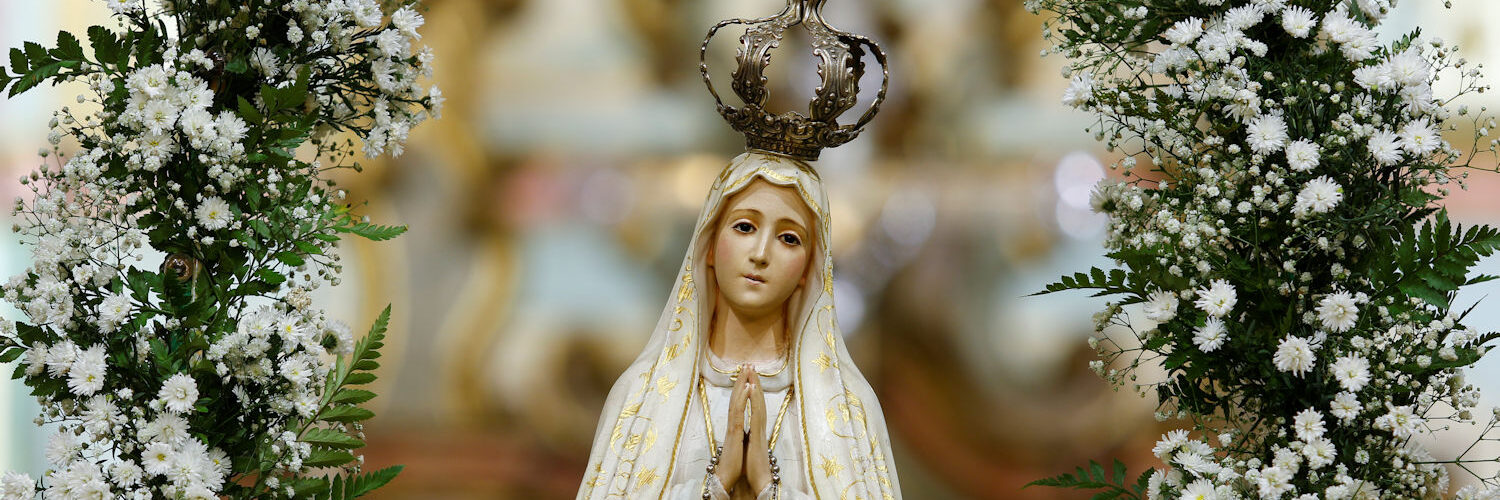
1. The Holy Virgin Mary, Mother of God Let us
then turn our attention first to the Holy Virgin, Mother of God,
the Theotokos. Divine Providence has brought us Catholics
together in this Basilica, the first Marian church of Rome and of
the West.Although we come from diverse parts of the world,we are
united in the same faith and turn to her, the Mother of God,
happy to have been received in her house in this year of the Rosary
proclaimed by the Holy Father.
Salve, sancta Parens, enixa puérpera Regem, qui coelum terramque
regit in saecula saeculorum.
Everything in this holy temple speaks of the Mystery of the Incarnation
of the Word of God in the womb of the Virgin Mary. Here she
appears to us in permanent relation to the august mystery of the
Most Holy Trinity. The Father, who, in His plan of Salvation,
deigned to send His Son into the world , asks of Mary of Nazareth
her agreement and consent. The Holy Spirit makes fruitful
the ark of the new alliance, the golden temple. And behold
the miracle : ecce concipies in utero et paries filium et vocabis
nomen eius Iesum. Mary gives flesh to the eternal Word (cf.
Lk. 1:30-38).
But this temple does not only carry us in spirit to Bethlehem
, to the "et incarnatus est" of our profession of faith,
of which the "confessio", beneath this altar with its
venerated relics of the manger is a permanent record. This
basilica also speaks to our common hope in the resurrection and
the glory. It is enough to contemplate the splendid mosaic
in the apse: Mary, from the moment of the Annunciation to that of
her glorious Assumption. It is the whole life of the Blessed
Virgin Mary which is presented to the prayerful contemplation of
the believer: the mystery of our entire existence.
In fact, one of the intuitions of the Second Vatican Council,
in continuity with the whole Tradition of the Church, is the relationship
which is established between the Blessed Virgin Mary and the Church,
of which She is the most eloquent icon. The eigth chapter
of the dogmatic Constitution "Lumen Gentium" is dedicated
to the "Blessed Virgin Mary, Mother of God in the mystery of
Christ and of the Church". "Recognized and honored
as the true Mother of God and of the Redeemer", she is, equally,
"the daughter of the Father's predilection and the temple of
the Holy Spirit", and, at the same time, "member of the
Church and her image and most excellent model in faith and in charity,
whom the same Catholic Church, enlightened by the Holy Spirit, venerates
with the affection of filial piety, as a most beloved mother"
(Lumen gentium, no.53).
In this manner the same Council presents to
us the Holy Virgin, always present to the daily vicissitudes of
the Church, of every one of her members, and at the same time draws
her close to our heart as the Auxilium Christianorum. In her
we contemplate the whole beauty of the Church, known and born in
the divine heart of her Founder, in Whom everything is light and
there are no shadows. The shadows which darken the Church's progress
through history are cast by the human nature of her members, sinners
poor and always in need of conversion and salvation.
2. The Successor of Peter The second figure intensely
present to us to-day is the venerable person of the Holy Father,
the Bishop of Rome and, as such, the Successor of Saint Peter. He
is -- as the Second Vatican Council teaches in continuity with Vatican
I -- "the perpetual and visible principle and foundation of
the unity, both of the Bishops, and of the multitude of the faithful"
(Lumen gentium, 23;cf.Vatican I, Pastor Aeternus, Preamble DZ
3050-3051).
Among the waves of history, he is "The Rock". This
is the Aramaic expression used by the Divine Founder of the Church
in reference to Simon, as reported in the 16th chapter of the Gospel
of Saint Matthew. But in order better to understand the thought
of Christ regarding the "rock", let us turn to the epilogue
to the 7th chapter of the same Gospel. For Jesus the "Rock",
or Peter, is that upon which an edifice can withstand the most terrible
storms .We see the significance of the name conferred on Peter.The
concept "Rock" signifies consistency, resistance,
cohesion, firmness, solidity, and strength.
With the eloquence which is characteristic of him, Saint Leo
the Great taught: "This disposition of the Truth remains forever:
and Peter, persevering with the solidity of the rock assigned to
him, never again abandoned the rudder of the Church . He in
fact was placed before all others and, thus, when he was named
"Peter" and "Foundation", when he was
constituted "guardian of the Kingdom of Heaven", and arbiter
with power to bind and to loose, and to pass judgements
which shall remain stable even in Heaven, we learnt the nature of
his union with Christ through the mystery of these titles"
(St. Leo the Great , Sermo 3).
Our beloved Pope John Paul II is the object of our thoughts,
our prayers, and our profound and affectionate sense of ecclesial
communion . In these twenty-five years, his life and his supreme
apostolic ministry have been characterized by an unwearying defense
of the Truth, by a total dedication to the cause of the unity of
the Church and by prophetic and courageous pastoral work for
the promotion of a true and just peace among peoples and among men.The
weaker his physical condition,the more strongly does he exercise,
in the sight of all humanity, his moral and spiritual authority.
"And thou,... confirm thy brethren!" (Lk 22:32).
We are very much aware of the storms and of the disbelief which
present in the Mystical Body of Christ. Such is the lot of
the Church, divine in her essence and human in her members. We
suffer from the many contradictions which human nature and sin can
inflict upon us through the painful history of our humanity and
in the Church's pilgrimage towards her ultimate Fatherland. But,
we are invited constantly to renew our trust in the Lord of
History, the Founder and invisible Head of the Mystical Body: "Do
not be afraid...I have conquered the world." (Jn 16:33)
The Church is victorious through the permanent assistance of
the Holy Spirit, the guarantee of the stability of the Catholic
faith: "and the gates of hell shall not prevail" (Mt 16:18),victorious
because the Sacraments assure us the grace which
transforms and sanctifies. The Church is victorious, because she
is constructed upon the rock of Peter, which is nothing other than
the rock of Christ; victorious again because, in communion
with her legitimate Pastors ,that note of catholicity is guaranteed
which is indispensable for remaining in the mystical community of
the Body of Christ. The Church is victorious finally
in her Saints: many and expressive are the figures of outstanding
sanctity with which the Holy Father has expanded the calendar of
Saints, in the course of this quarter century of his Supreme Pontificate!
"Duc in altum!", exclaims John Paul II and in him there
resounds the voice of the Good Shepherd Himself. "Men
of little faith, why do you doubt?", "Cast out the nets
for a catch . . . Launch out into the deep!"
And they enclosed a very great multitude of fishes (cf. Lk
5:4).
"Duc in altum!" Let us launch out into the deep in
the bark of Peter. With Saint Leo the Great, let us reaffirm
our faith: "The solidity which he, Peter, become rock, takes
from the rock of Chirst, is propagated even in his heirs . .
." (St. Leo, Sermon V). Let us say with St. Jerome:
"I do not follow a primacy which is not that of Christ; through
this I put myself in communion with the chair of Peter." (Letter
to Damasus)
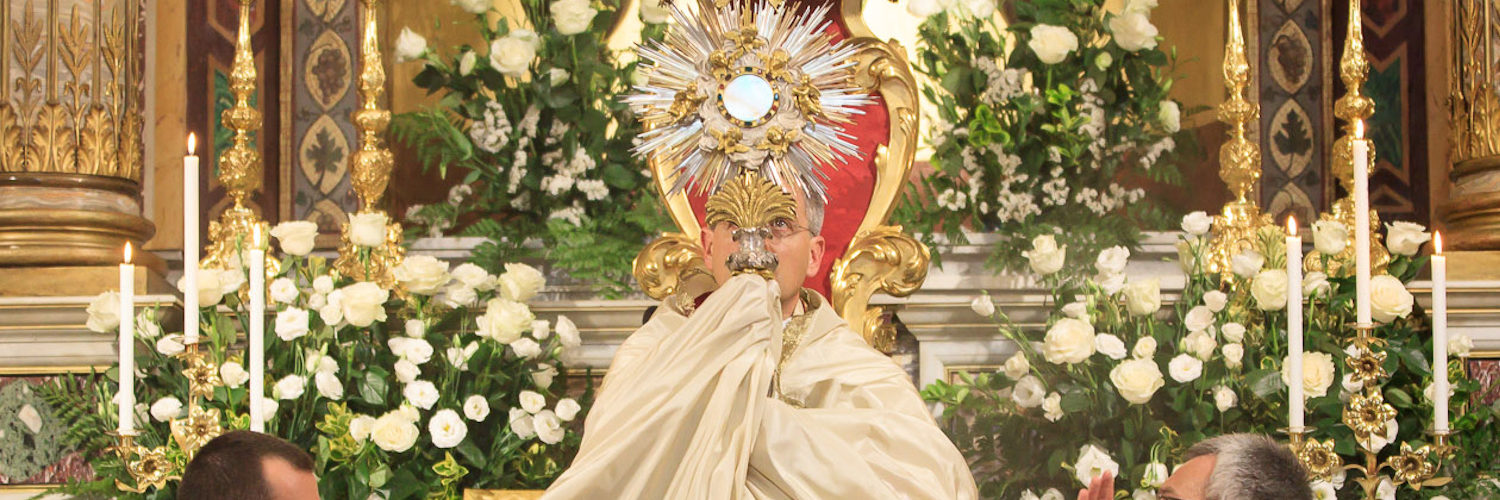
We are here to pray with the Auxilium Christianorum ,to embrace
the Vicar of Christ with the warmth of our affection, and we do
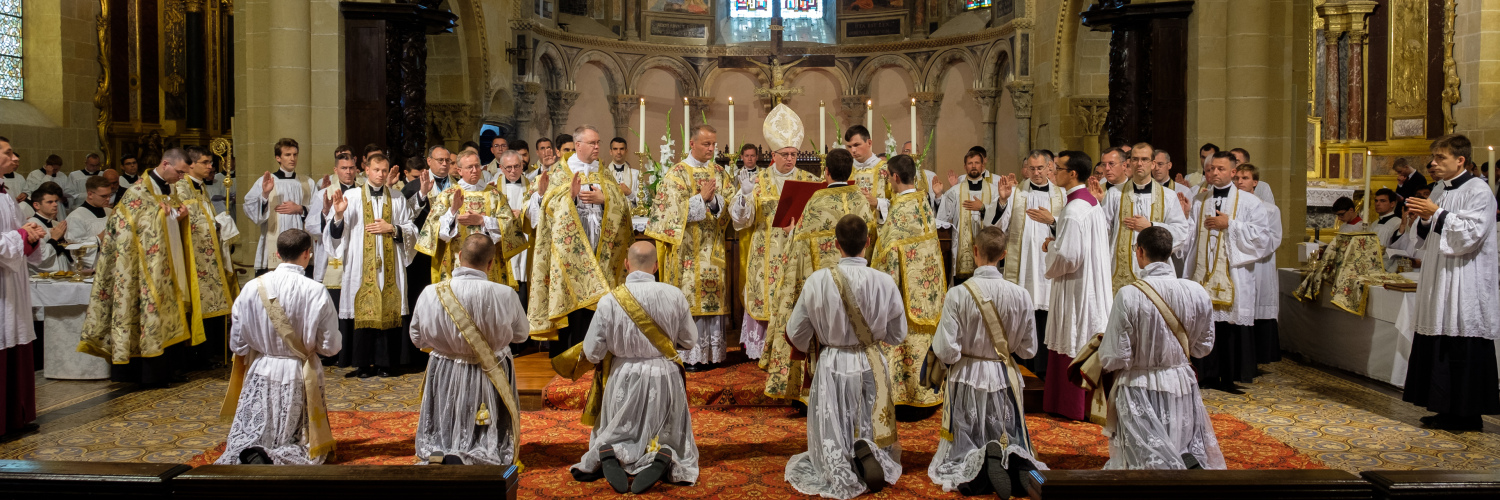
this with the most powerful reality that exists: the Holy Sacrifice
of the Mass, with which "the work of our redemption is accomplished"
(Vatican II, Sacrosanctum Concilium, n. 2).It is a reality
absolutely omnipotent, renewing in an unbloody manner the unique
Sacrifice of the Cross, rendering substantially present the Body
and the Blood of Christ. The one and only Savior represents
in the rites of this Holy Mass the infinite fruit of the bloody
Sacrifice of the Cross, offered on account of our sins.
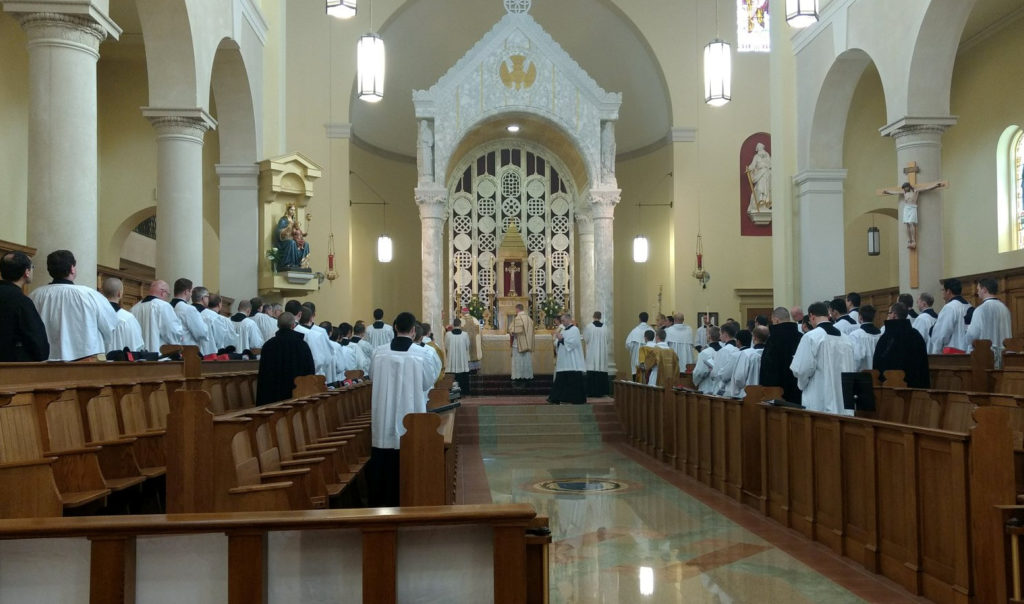
3. The Venerable Rite of Saint Pius V A providential
co-incidence permits us to render worship to God to-day, and
to celebrate the divine Sacrifice according to the roman rite of
the Missal of Saint Pius V, whose mortal remains repose nearby
in this Basilica. Here is the third figure present in this
celebration.
You yourselves, dearest faithful, particularly
sensitive to this rite that has, throughout the centuries, constituted
the official form of the roman Liturgy, have taken the initiative
for today's celebration. And I am very happy to be able to
accede to your request, made by many more than those present
here to-day, both because it is animated with a filial devotion
to the Holy Father, nigh on the occasion of the twenty- fifth anniversary
of His Pontificate, and because of the recognition of the fruits
of holiness which the Christian People have obtained from the Most
Holy Eucharist in the accordance with this rite.
The rite of Saint Pius V cannot be considered to be extinct
and the Authority of the Holy Father has expressed his benevolent
recognition of the faithful who, though recognizing the legitimacy
of the roman rite renewed according to the indications of the Second
Vatican Council, remain attached to the preceding rite and find
in it valuable spiritual nourishment in their journey of sanctification.
On the other hand, the same Second Vatican Council declared
that " . . . Holy Mother Church considers as having
equal rights and honor the legitimate recognized rites, and she
wills that in the future they be conserved and in every way fostered,
and desires that, where it is necessary, they come to be prudently
revised in an integral manner in the spirit of holy tradition and
come to be given a new vigor according to the circumstances and
necessities of our time" (Sacrosanctum Concilium, n. 4)
The ancient roman rite hence conserves in the Church its right
of citizenship among the multiformity of Catholic rites, both Latin
and Oriental. That which unites the diversity of these rites
is the one faith in the Mystery of the Eucharist, the profession
of which has always assured the unity of the Holy, Catholic, and
Apostolic Church.
John Paul II, celebrating the tenth anniversary of the Motu Propio
"Ecclesia Dei", exhorted "all Catholics to accomplish
gestures of unity and to renew their own attachment to the Church,
so that their legitimate diversity and different sensibility, worthy
of respect, does not separate them one from another, but rather
encourages them to announce the same Gospel; with the result that,as
the Holy Father proceeds, urged by the Holy Spirit who makes
all charisms flow together into unity, all will be able
to glorify the Lord and salvation be proclaimed to all nations."
(Osservatore Romano, n. 26-27, Oct. 1998, p. 8)
All this constitutes a special motive of gratitude for the Holy
Father. We are grateful from our hearts for the exquisite
and paternal comprehension which He shows towards those who desire
to maintain alive, in the Church, the riches represented by this
venerable liturgy, which nourished his infancy and youth,
which was that of his priestly ordination, of his first Mass, of
his episcopal consecration, and which hence forms part of
his most beautify spiritual crown of memories.
I know that you are immensely grateful to the Holy Father for
the invitation given by him to the Bishops of the whole world "
to be understanding towards, and to have a renewed pastoral
consideration for the faithful bound to the ancient rite and, at
the threshold of the third millennium, to help all Catholics to
live out the celebration of the holy mysteries with a devotion that
amounts to a true nourishment for their spiritual life and a
source of peace" (loc.cit.):a devotion which, as St. Thomas
Aquinas teaches, should be supreme "proper hoc quod in hoc
sacramento totus Christus continetur" (III, q. 83, a.
4, ad 5).
We are all called to unity in the truth, with mutual respect
for diversity of opinions, upon the base of the same faith,
proceeding "in eodem sensu" and mindful of the saying
of Augustine: "in necessariis unitas, in dubiis libertas, in
omnibus caritas".
In the name of all of you and of all those who are today associated
with us in this celebration, I address again the following words
with the Holy Church, to the Most Holy Trinity, Who has given us
Mary as a helper: "concede propitius, ut, tali praesidio muniti
certantes in vita, victoriam de hoste maligno cónsequi valeámus
in morte" (Missale Romanum, Mass of the Feast, Collect).
Praised be Jesus Christ
|