
Spirituality Year of the Rosary
The
year running from Oct. 2002 - Oct. 2003 has been declared the "Year
of the Rosary" by Pope, John-Paul II (cf. Apostolic
Letter "Rosarium
Virginis Marić", 16th of
October 2002). We will post articles on this "prayer loved
by so many saints and encouraged by the Magisterium of the Church".
September
- October 2003: Rosary and contemplation
Mary, model of contemplation
10.
The contemplation of Christ has an incomparable model in Mary. In
a unique way the face of the Son belongs to Mary. It was in her
womb that Christ was formed, receiving from her a human resemblance
which points to an even greater spiritual closeness. No one has
ever devoted himself to the contemplation of the face of Christ
as faithfully as Mary. The eyes of her heart already turned to him
at the Annunciation, when she conceived him by the power of the
Holy Spirit. In the months that followed she began to sense his
presence and to picture his features. When at last she gave birth
to him in Bethlehem, her eyes were able to gaze tenderly on the
face of her Son, as she “wrapped him in swaddling cloths, and laid
him in a manger” (Lk2:7). Thereafter Mary's gaze, ever filled
with adoration and wonder, would never leave him. At times it would
be a questioning look, as in the episode of the finding in the Temple:
“Son, why have you treated us so?” (Lk 2:48); it would always be
a penetrating gaze, one capable of deeply understanding Jesus, even
to the point of perceiving his hidden feelings and anticipating
his decisions, as at Cana (cf. Jn 2:5). At other times it would
be a look of sorrow, especially beneath the Cross, where her vision
would still be that of a mother giving birth, for Mary not only
shared the passion and death of her Son, she also received the new
son given to her in the beloved disciple (cf. Jn 19:26-27). On the
morning of Easter hers would be a gaze radiant with the joy of the
Resurrection, and finally, on the day of Pentecost, a gaze afire
with the outpouring of the Spirit (cf. Acts 1:14).
Mary's memories 11. Mary lived with her eyes fixed
on Christ, treasuring his every word: “She kept all these things,
pondering them in her heart” (Lk 2:19; cf. 2:51). The memories of
Jesus, impressed upon her heart, were always with her, leading her
to reflect on the various moments of her life at her Son's side.
In a way those memories were to be the “rosary” which she recited
uninterruptedly throughout her earthly life. Even now, amid the
joyful songs of the heavenly Jerusalem, the reasons for her thanksgiving
and praise remain unchanged. They inspire her maternal concern for
the pilgrim Church, in which she continues to relate her personal
account of the Gospel. Mary constantly sets before the faithful
the “mysteries” of her Son, with the desire that the contemplation
of those mysteries will release all their saving power. In the recitation
of the Rosary, the Christian community enters into contact with
the memories and the contemplative gaze of Mary.
The Rosary, a contemplative prayer 12. The Rosary,
precisely because it starts with Mary's own experience, is an exquisitely
contemplative prayer. Without this contemplative dimension, it would
lose its meaning, as Pope Paul VI clearly pointed out: “Without
contemplation, the Rosary is a body without a soul, and its recitation
runs the risk of becoming a mechanical repetition of formulas, in
violation of the admonition of Christ: 'In praying do not heap up
empty phrases as the Gentiles do; for they think they will be heard
for their many words' (Mt 6:7). By its nature the recitation of
the Rosary calls for a quiet rhythm and a lingering pace, helping
the individual to meditate on the mysteries of the Lord's life as
seen through the eyes of her who was closest to the Lord. In this
way the unfathomable riches of these mysteries are disclosed”. (John-Paul II in
"Rosarium
Virginis Marić", 16th of
October 2002)
July
- August 2003: Leo XIII and the Rosary
Pope
Leo XIII is known for his development of the social doctrine of
the Church, but few people remember that he used to be called the
Pope of the Rosary. In an age “when all evils combine to oppress
the Church under their weight”, Leo XIII had recourse to a line
of action that had born rich fruits in the past, and exhorted a
return to the Holy Rosary of St. Dominic and St. Pius V.
This is why in his encyclical of 1st September 1883 he “decrees
and orders that throughout the whole Catholic world the following
feast of Our Lady of the Rosary be celebrated with a particular
piety and with all the solemnities of the cult: from 1st October
to 2nd November at least five decades of the Rosary are to be recited
piously in all parish churches followed by the Litanies of Loretto.“
In a declaration of 24th December 1883 the Holy Father expressed
his joy that the Catholic people had everywhere been so obedient
to his orders. He asked for perseverence in this practice. On 30th
August 1884 he renewed for the month of October the prescriptions
of the previous year. “Since the attack by the enemies of Christianity
is unrelenting, the constancy and energy of the defenders should
be no less vigorous…”
On the 20th August 1885 a decree of the Sacred Congregation of
Rites ordered that the practice be continued every year as long
as this sad state of affairs lasts for the Church and for public
affairs.” In the course of the extraordinary jubilee of 1886 the
Pope decided to place the jubilee under the patronage of Our Lady
of the Rosary. The jubilee year had not ended, with the devotions
of the month of the Rosary still in progress, before the Pope wrote
to Cardinal Parocchi on the 26th October 1886, his vicar for the
city of Rome, that he should establish the daily recitation of the
Rosary in the parishes of Rome.
On the 15th August 1889, this time in an encyclical, he inculcated
once more in the faithful the necessity of constant prayer to the
celestial powers in the combat against the forces of Satan. Having
shown in a wonderful fashion the importance of St. Joseph’s titles
as patron of the Universal Church, he asked that this great saint
be invoked during the month of October at the same time as Mary.
This is the reason why a prayer to St. Joseph composed by Leo XIII
is recited every day of this month after the Rosary before the Blessed
Sacrament.
In short, since 1st September 1883 when the Pope had established
by concrete facts the marvellous power of the prayer of the Holy
Rosary, he was pleased to insist upon its recitation no less than
seven times more. In an encyclical of 22nd September 1891, while
changing his method and raising the tone, he considered the Rosary
in itself. In magisterial fashion he analysed this Marian devotion
and revealed the secret of its incomparable value. He shows how
Mary is the Mediatrix in the Economy of Salvation. Our prayers must
therefore be addressed to her with confidence, and of all the methods
of prayers that there are none is to be preferred to the Holy Rosary:
it is such a marvellous composition of meditation and vocal prayer
that one would not imagine a method more agreable to the Virgin
or more salutary for our souls.
For several years in a row at the approach of the month of October
great encyclicals continued to appear on the Rosary. That of 7th
September 1892 resumed in a first section the line of teaching begun
in the previous encyclical, and went on to develop the idea of the
Rosary as a remedy against the corruption of the world, because
it is such an easy means of impressing upon the mind the principal
dogmas of the Christian faith.
All of his encyclicals on the Holy Rosary would develop this
guiding principle, with the exception of the encyclical of 1895
which was concerned to show how the Rosary is a method of achieving
the spiritual union of souls.
Leo XIII wrote his last encyclical on the Rosary in 1898, announcing
in it his intention to crown his work by a final document, a constitution
on the rights and privileges enjoyed by the Confraternities of the
Rosary. This apostolic constitution of 2nd October 1898 was followed
on 30th August 1899 by the official catalogue of the indulgences
of the Rosary. With his Marian work accomplished, Leo XIII gave
up his soul to God on the 20th July 1903.
May
- June 2003: Encyclical of Pope Pius XII Ingruentium Malorum
on reciting the Rosary
12.
But it is above all in the bosom of the family that We desire the
custom of the Holy Rosary to be everywhere adopted, religiously
preserved, and ever more intensely practiced. In vain is a remedy
sought for the wavering fate of civil life, if the family, the principle
and foundation of the human community, is not fashioned after the
pattern of the Gospel.
13. To undertake such a difficult duty, We affirm that the custom
of the family recitation of the Holy Rosary is a most efficacious
means. What a sweet sight - most pleasing to God - when, at eventide,
the Christian home resounds with the frequent repetition of praises
in honor of the august Queen of Heaven! Then the Rosary, recited
in common, assembles before the image of the Virgin, in an admirable
union of hearts, the parents and their children, who come back from
their daily work. It unites them piously with those absent and those
dead. It links all more tightly in a sweet bond of love, with the
most Holy Virgin, who, like a loving mother, in the circle of her
children, will be there bestowing upon them an abundance of the
gifts of concord and family peace.
14. Then the home of the Christian family, like that of Nazareth,
will become an earthly abode of sanctity, and, so to speak, a sacred
temple, where the Holy Rosary will not only be the particular prayer
which every day rises to heaven in an odor of sweetness, but will
also form the most efficacious school of Christian discipline and
Christian virtue. This meditation on the Divine Mysteries of the
Redemption will teach the adults to live, admiring daily the shining
examples of Jesus and Mary, and to draw from these examples comfort
in adversity, striving towards those heavenly treasures "where
neither thief draws near, nor moth destroys" (Luke 12, 33).
This meditation will bring to the knowledge of the little ones the
main truths of the Christian Faith, making love for the Redeemer
blossom almost spontaneously in their innocent hearts, while, seeing,
their parents kneeling before the majesty of God, they will learn
from their very early years how great before the throne of God is
the value of prayers said in common.
15. We do not hesitate to affirm again publicly that We put great
confidence in the Holy Rosary for the healing of evils which afflict
our times. Not with force, not with arms, not with human power,
but with Divine help obtained through the means of this prayer,
strong like David with his sling, the Church undaunted shall be
able to confront the infernal enemy, repeating to him the words
of the young shepherd: "Thou comest to me with a sword, and
a spear, and with a shield; but I come to thee in the name of the
Lord of Hosts, the God of armies . . . and all this assembly shall
know that the Lord saveth not with sword and spear, for this is
his battle, and he will deliver you into our hands" (I Kings
17, 45-47).
March
- April 2003: The Battle of Lepanto and the development of devotion
towards the Holy Rosary
The
sixteenth century was marked by the expansion of the Ottoman Empire.
The Turks, who already occupied most of the Mediterranean,
Northern Africa, the Middle East and the Balkanic Peninsula, were
threatening Western Europe. They took Belgrade in 1521, held
Rhodes the following year, and then invaded Hungary and sieged Vienna
in 1529. They were driven back by a tiny margin and run aground
at Malta, retreating to take Cyprus, a then Venitian possession.
Faced with the Turkish threat, Europe did not combine forces
well. France even maintained friendly relations with Constantinople.
Under such unvafourable circumstances, Pope St Pius V patiently
but persistently endeavoured to form a coalition against the Turks
amongst the various European kingdoms. Ha finally managed
to establish an alliance with Spain, Venice and Malta. In
May 1571, St Pius V solemnly proclaimed from St Peter's Basilica
the establishment of the Holy League. An impressive fleet
was formed, entrusted to Don Juan of Austria, the brother of King
Philip II of Spain. To beseech heavenly protection over the
fleet, St Pius V ordered a solemn jubilee together with fasting
and the public recitation of the Rosary.
The decisive battle took place on October 7, 1571 in the golf
of Lepanto, outside the isthmus of Corinth. It involved 213
venitian and spanish galleys et some 300 turkish galleys. Approximately
100,000 men fought on each side. The Christian fleet won a
full victory, due to the heavy artillery that had been taken on
board. Almost all enemy galleys were either taken or sunken.
Turkish Admiral Ali Pacha was made prisoner and beheaded.
Fifteen thousand christian prisoners were freed. Barely
one third of the Turkish fleet managed to get away, thus sweeping
away the legend of invincibility of the Turkish fleet.
On
the very evening of the battle, Pope St Pius V suddenly left his
desk for the window, where he appeared to contemplate a vision.
Then he turned to the surronding prelates and said: "Let
us give thanks to God: our army is victorious". It was
October 7 shortly before 5 p.m., that very hour at which Don Juan,
victorious, knelt on the bridge of his ship to thank God for His
protection. The news of victory did not reach Rome until October
26, 19 days later, thus confirming the revelation granted to the
Holy Father.
In memory of the battle of Lepanto, Pius V added the following
invocation to the litanies of the Blessed Virgin Mary: "Help
of Christians, pray for us", and ordained the institution of
the Feast of Our Lady of Victories, which Pope Gregory XIII then
established as the Feast of the Rosary in all churches each first
Sunday in October.
Throughout the catholic people the victory of Lepanto soon contibuted
to the rapid expansion of devotion towards the Rosary et gave rise
to the creation of many confraternities. It remains a key
date in the history of Marian devotion.
January
- February 2003: The Ave Maria
We
normally think of the Lord’s Prayer as the prayer received from
God, but the Hail Mary is another such prayer. The difference is
that the Lord’s Prayer was received from God: from Our Lord Jesus
Christ Himself; whereas the Hail Mary was received indirectly from
God: from the Angel Gabriel who brought the annunciation from the
Most Holy Trinity, and from St. Elisabeth who blessed the Holy Virgin
on the inspiration of the Holy Ghost. The words of the Angel Gabriel
began: Hail full of Grace the Lord is with thee, blessed art thou
amongst women. The words of St. Elisabeth began: Blessed art thou
amongst women and blessed is the fruit of thy womb. She goes on
to say: whence is this to me that the mother of my Lord should come
to me? Comparing these salutations with our prayer we notice that
in our prayer the names Jesus and Mary are added; that the blessing
“blessed art thou amongst women” is (on the inspiration of God)
repeated in the words of St. Elisabeth; that the words “Mother of
my Lord” become in our prayer “Mother of God” (noting that the name
Lord refers to God in the Bible).
As St. Louis-Marie Grignon de Montfort remarks in his book The
Secret of the Rosary, the Hail Mary is a prayer formulated by God
announcing the Incarnation and hence giving unlimited glory to the
Blessed Trinity, Our Blessed Lord and the Blessed Virgin. Let us
now briefly look at the four parts of the prayer: the forms of address
(‘Hail Mary’ and ‘Mother of God’), the Grace possessed by Our Lady,
and the petition at the end of the prayer.
First then, the form of address “Hail Mary”. Saint Louis-Marie
recounts a vision of St. Mechtilde in which Our Blessed Lady said:
“My daughter, I want you to know that no-one can please me more
than by saying the salutation which the Most Adorable Trinity sent
to me and by which He raised me to the dignity of Mother of God.”
There follows an interpretation of the salutation of which we shall
repeat only the beginning. “By the words Ave (which is the name
Eve, Eva), I learned that in His infinite power God has preserved
me from all sin and its attendant misery which the first woman had
been subject to. The name Mary which means ‘Lady of Light’ shows
that God has filled me with wisdom and light like a shining star,
to light up heaven and earth…”
Let us proceed to look briefly at the title Mother of God. Already
contained in the address of St. Elisabeth, this title was proclaimed
dogmatically in the Council of Ephesus in the year 430. This Council
condemned the heresy of Nestorius, Patriarch of Constantinople.
The Nestorian heresy teaches that the two natures of Christ, the
Divine and the human nature, belong to two persons, a Divine and
a human person united in Christ: the Blessed Virgin is the Mother
only of the human person. The truth by contrast is that the two
natures of Christ, the divine and the human natures, belong to one
person who is the Divine Person, the Second Person of the Holy Trinity,
the Son. Since the Blessed Virgin is the Mother of this Divine Person,
she is truly the Mother of God.
Now a word about the fullness of Grace that the Blessed Virgin
Mary possesses. This fullness of Grace derives from the fact that
she is the Mother of God: She is full of Grace because the Lord
is with her; she is blessed amongst women because the fruit of her
womb is blessed. St. Thomas explains that she possesses the fullness
of Grace because she is in the closest proximity to the source of
Grace, Who is Christ. This fullness of Grace therefore exceeds the
degree of Grace of the highest angels and saints, so that the Blessed
Virgin may indeed be compared to a shining star that illuminates
heaven and earth.We conclude with the interpretation of St. Louis-Marie
de Montfort of the petition at the end of the prayer: ‘Pray for
us now during this short life so fraught with sorrow and uncertainty,
pray for us now – now because we can be sure of nothing except of
the present moment. Pray for us now that we are being attacked night
and day by powerful and ruthless enemies. Pray for us now and at
the hour of our death: so terrible and full of danger when our strength
is waning and our spirits are sinking, and our souls and bodies
are worn out with fever and pain. Pray for us, then, at the hour
of our death when the devil is working his hardest to enslave us
and to cast us into perdition. Pray for us at the turning point
when the die will be cast once and for all and our lot forever and
ever will be Heaven or Hell… Intercede for us and ask thy Son to
forgive us and let us into the ranks of the blessed, thy elect,
in the realm of everlasting glory.’ Amen.
November
- December 2002: History of the Rosary
I. The origins of the Rosary: from Psalter to Ave Maria
I n
order to understand how the devotion of the Rosary developed, one
must look above all to another, much older form of piety: the recitation
of the psalms. Since the very beginnings of Christianity the psalter
has enjoyed the primary place as form of prayer, both collective
and personal. Composed of 150 psalms, the psalter is divided - probably
by Origen (d. 254 A.D.) - into three equal parts of 50 psalms each.
This division was in reference to the Holy Trinity, according to
St. Hilary of Potiers, commenting a hundred years later (d. 367
A.D.). This distribution of the psalms, even if not used for the
recitation of the Divine Office, continues to be used in various
ways. We see, for example, in religious orders that upon the death
of a fryar, while the priests offered the Sacrifice of the Mass,
the lay brothers recited 50 psalms for their deceased brother. 150
psalms, three groups of 50: this is the distant origin of the Rosary
- 150 Ave Marias, 5 "decades" in each of the mysteries.
The change from reciting psalms to repeating a single prayer
occurred sometime afterwards when the lay brothers, lacking instruction,
had need of more simple forms of prayer. Some recommended they recite
a single verse 2606 times (the total number of verses in all 150
psalms), recite the same psalm 150 times, or again, substitute an
Our Father for each psalm. In the 12th and 13th centuries Marian
piety grew together with the Ave Maria, considered now as
one of the prayers to be learned by heart. At that time the Ave
consisted of the two angelic salutations of St. Gabriel and St.
Elisabeth, the name of Jesus being attributed to Pope Urban IV around
the year 1263.
Thanks to the influence of the Cistercians who made it popular,
the Ave Maria became a repeated invocation added or even
substituted for the Our Father. By analogy with the psalter, the
Ave Maria began to be recited in groups of 50 and, in order
to avoid the danger of a purely mechanical recitation, the prayer
was enriched with Marian antiphons in the same way as the psalms.
The Rosary became, therefore, "Our Lady’s Psalter",
sometimes called a "chaplet" (chapeau, French for hat)
in reference to the crown of flowers offered to images of the Blessed
Virgin.
II. The mysteries of the Saviour
The
framework of the rosary was thus constituted and it was on this
framework that the meditation of the salvific work of Christ would
develop. The life of Jesus, of course, was the subject of contemplation
long before the institution of the Rosary: already in the 3rd century
Tertullien and St. Cyprien linked the hours of the Divine Office
to the memory of the different moments of Christ’s Passion. In the
middle ages this practice grew more complete. The sermons of St.
Bernard of Clairvaux (d. 1153 A.D.) on the Canticle of Canticles
provided the basis for a meditation on the life of Jesus, the Annunciation,
and the apparition of the Risen Saviour to St. Madeleine. But it
was St. Aldred of Rielvaux (d. 1167 A.D.), in his Life of a Recluse,
who was the first to put into practice a systematic meditation,
prefiguring the method of the Carthusian, St. Rudolph of Saxony,
and that of St. Ignatius of Loyola. In this context, the Ave
Maria - which concluded at this time with praise of the fruit
of the Mary’s womb - lent itself to meditation on the life of
the Son of God, made flesh and born of the Virgin.
According to what we now know, it was towards the year 1300 that
a series of Ave Marias was recited systematically with a
meditation on the fruits of the Incarnation. This happened in the
Cistercian monastery of St. Thomas-on-Kyll, in the region of Trier.
The Marian prayer was recited a hundred times, each time followed
by a phrase intended to aid in contemplating a redemptive work of
Christ: "Hail Mary...and blessed is the fruit of Thy womb,
Jesus, …because he has created us in His image and likeness...because
He chose you from all eternity to be his mother...."
A century later, Dominic of Prussia (d. 1460 A.D.) of the Saint
Alban Carthusian monastery of Trier, affirmed in his biography that
he was the first to add the subjects of meditation during recitation
of the Rosary. It is he at least who had the idea to systematically
link the recitation of the Rosary with contemplation of the life
of Christ, dividing the prayer into 50 groups and editing a short
text intended to follow each Ave Maria. He extended this
method to the entire Marian psalter and composed three series of
50 phrases on the infancy, public life and Passion of Our Lord.
The double principle of the Rosary, both Marial and Christocentric,
was thus achieved.
III. Later developments
In
the 14th century and during the centuries that followed, the Rosary
underwent various additions and modifications, touching more the
form than the principle itself of this prayer. The division of
the Rosary into 10 "decades", each separated by the recitation
of an Our Father, was the contribution of a Carthusian from Cologne,
Henry Egher of Kalkar (d. 1408 A.D.).
Confraternities of the Rosary began to appear at the end of the
15th century, of which the first was founded in Cologne in 1475.
This became the means for the Dominicans to spread the Rosary throughout
all of Christianity. At the same time, the many meditations of the
life of Christ - or "mysteries" - were fixed at 15, divided
into the joyful, sorrowful and glorious mysteries.
Under the influence of popular piety, the text of the Ave
Maria was enlarged and transformed into a prayer of supplication.
It was in the time of St. Peter Canisius (1521-1597) that the invocation
"Holy Mary, Mother of God, pray for us sinners" gradually
spread. We also find other additions: "now and at the hour
of our death" (15th century). The Ave Maria took its
definitive form with St. Pius V when he included it in the Breviary
of 1568. According to his missionary methods, St. Louis Marie
Grignon de Monfort (1673-1716) preceded the recitation of the Rosary
by the praying of a Credo, an Our Father and three Hail Marys.
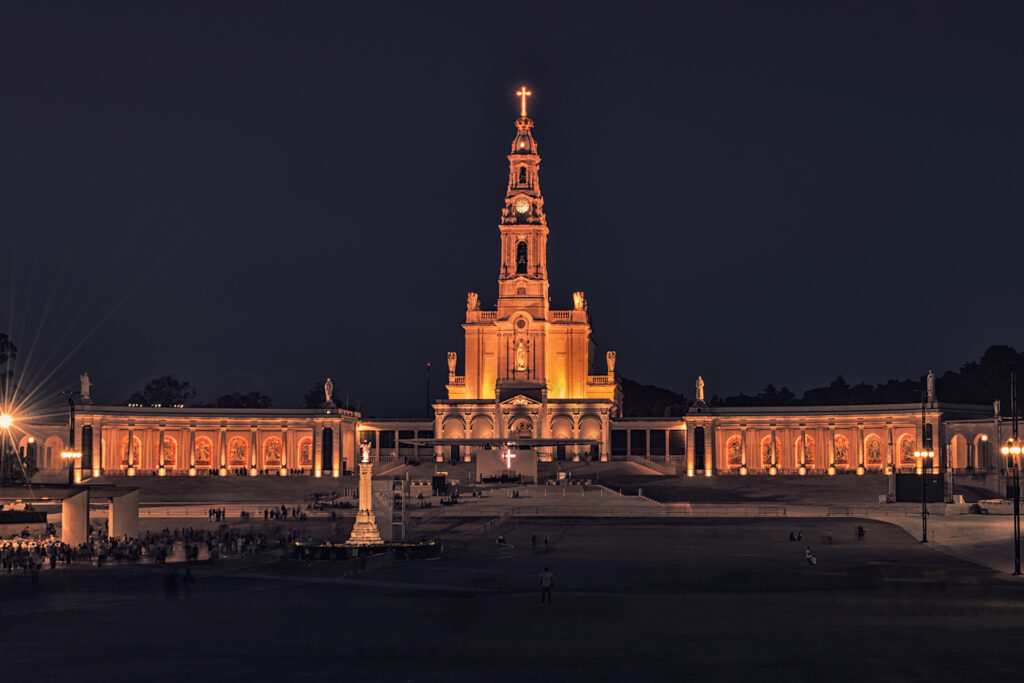
On July 13th 1917, Our Lady, appearing at Fatima, requested that
after each "decade" we pray "Oh my Jesus, forgive
us our sins, save us from the fires of Hell; lead all souls to heaven,
especially those in most need of Thy mercy."
Finally, after announcing the beginning a Marian year from October
2002-2003, the current Holy Father proposed the addition of a fourth
"decade" entirely centered on the public life of Jesus
- the Luminous Mysteries : the baptism of Our Lord, the miracle
at the Marriage of Cana, the proclamation of the Kingdom of God,
the Transfiguration and the institution of the Holy Eucharist.
|